Another lovely day, in the city of Chicago, and I’m out driving, picking up clients and taking them to where they need to go.
I take in a request from Lakeview and pick up my client. I drive towards the destination by getting on the expressway. After 15 minutes of driving, due to heavy traffic, we finally make it to Ohio St. and Wells St. I turn right going south on Wells Street, which is a one-way street, staying in the right driving lane with the bike lane just to the right of me. As I approach the destination, at Wells and Wolf Point Plaza, I look in the side mirror and see an empty bike lane. As I pull to the right to drop of my client at the destination, I hear yelling and see a bicyclist right behind me. As I stop to let the client out of my vehicle, the biker rides by and slaps my driver’s side mirror.
Now I realize how this biker may have been upset that I apparently cut him off, and I was kind of feeling bad, but he didn’t have to hit my car as he rode by. I mean, what if he cut me off and I drove by him and hit his handlebars? I probably wouldn’t be here writing this blog. Well here is my take on Bikes on the Street.
The city of Chicago, as many as other cities, has created a bike-friendly city by making bike lanes. These bike lanes are painted on the streets where cars and trucks drive. They are NOT separate from traffic or far away from cars, it is right next to driving lanes. Also, in some areas, they have shared lanes which are, technically, unmarked bike lanes that they share with vehicles. Remember also, that in order to drive a car in Illinois, drivers have to pay for a city sticker, to be legal in the city and they have to pay for a license plate sticker, to be legal in the state of Illinois. We also have to have minimum liability insurance on the vehicles. That’s a few hundred dollars a month for insurance and a few hundred dollars a year for the stickers, depending on the size of the vehicle
 Now the bicyclists have some rules that they apparently have to follow. The DMV even has a rule book that bikers are supposed to read so they know the rules of the road. I’m sure they all have read this book before riding in the streets. If they haven’t read this book, they probably should as should all drivers. Bicyclists do NOT have to pay any money to use the streets. NO city sticker, no license plate requirements are necessary for bicyclists to use the streets. So I’m going over some of my pet peeves and how they are addressed by this wonderful book of rules.
#1. Staying in the bike lane. Many bicyclists continue to ride in the driving lanes instead of staying between the lines of the bike lane. In shared lanes, they ride in the middle of the shared lanes which holds up traffic because vehicles can’t go around the bikers. Also, while riding in the bike lanes, sometimes, bikers ride against traffic. Let’ see what the rules are for that: Page 2. Obey all Traffic Laws and Signals • When riding your bicycle on Illinois roadways, you must obey the same traffic laws, signs and signals that apply to motorists. • Bicyclists must ride in the same direction as other traffic. Riding in the opposite direction of traffic is both dangerous and against the law. • Motorists are required by law to allow at least 3 feet of space between them and a bicyclist when passing. Page 7. Ride as close to the right edge of the road as practical. Certain conditions allow a bicyclist to move farther to the left if necessary, such as broken glass, drain grates, parked cars, left turns and passing. Ride in the same direction as other traffic, not against traffic.
#2. Blocking the turning lanes. Sometimes, when I’m turning left, I’ll be the first vehicle in line to turn left when a bicyclists rolls up and gets in front of me. Now, when the light turns green, I can’t make my turn quickly because this biker is in the way and I have to wait for him to move to the right again. Same thing when turning right. The bikers get right in front of the right turning vehicles and use absolutely NO hand signals. I have yet to see a bicycle with turn signal lights. Let us see what the rules are for that: Page 3. Arm signals to ride safely in traffic.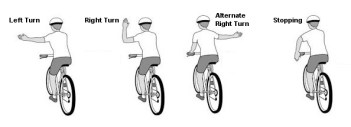 Bicycle riders must use their hands and arms to communicate to other motorists around them. There are four important arm signs you should know and use every time you prepare to turn or stop (see photo). Remember to signal, using your left or right arm, about one-third of a block before you plan to turn so vehicles behind you have ample time to slow down. Your eyes are an important safety tool when riding your bike. Watch other drivers closely to make sure they have seen you and your arm signal. Turning Right Turns — Right turns must be made from the right lane. Stay as close as practical to the right-hand curb or edge of the roadway. Left Turns — When making a left turn, a bicyclist has two choices: 1. Make the turn as a vehicle would. When a left-hand lane exists, stay in the right side of that lane, then after entering the intersection look in all directions and make the turn when safe. 2. Stay as close as practical to the right curb or edge of the roadway as you enter the intersection. Proceed straight across the roadway to the opposite corner, then wait out of the way of other traffic. After obeying any traffic control device, you may directly cross the street again to complete the turn in the new direction.
#3. Not stopping at red lights or stop signs. There have been many times where I am driving through an intersection, after stopping for a stop sign or after getting the green light and I almost hit a bicyclist crossing the intersection. Let’s see what the rules say about that: Page 4. Traffic Signals and Signs. Traffic signs and signals tell drivers when to stop and when to go. They warn of railroad crossings and other hazards and tell you where you may ride your bike. Bicycle riders, as well as drivers, must obey all traffic signs and signals. Traffic Light • Stop at a red light. • A yellow light is a warning that the light is about to turn red. Prepare to stop. • You may go on a green light, but first look carefully to see if it is safe to go. • A bicyclist may proceed, after yielding the right-of-way to oncoming traffic, through a red light that fails to turn green after waiting for at least 120 seconds in eligible communities. Flashing Red Light Stop. Look left, then right, then left again. Proceed when safe to do so. Flashing Yellow Light Slow down and ride carefully.
Right-of-Way Laws. – Right-of-way means that one person has the right to go ahead of another. This applies to bicycle riders, motorists and pedestrians. If others do not follow the rules, let them have the right-of-way to avoid the risk of an accident. Two-way Intersections — When you come to a stop sign at a two-way stop intersection, you must yield the right-of-way to pedestrians and vehicles on the cross street before you go ahead. Four-way Intersections — At a four-way stop intersection, the driver or bicycle rider who arrives first at the intersection should be the first to go. Take turns and go one by one through the intersection after coming to a complete stop. Proceed only when it is safe to do so. Unmarked Intersections — At an unmarked intersection or crossing where there are no traffic signs or signals, the driver or bicycle rider on the left must yield to those on the right. When driving out of an alley or driveway, you must stop and yield the right-of-way to pedestrians and vehicles before you cross the sidewalk or enter the street.
These are the 3 main pet peeves, of mine, and what the rules are. Hopefully bikers and motorists both gain something from this. Please be careful driving and riding out there. Be courteous and kind when engaging in disputes, and please don’t hit my car!
Please check it out: Illinois Bicycle Rules Of The Road
Thank you for reading and please, comment below!!!!


 Ride Share Revelations
Leave a comment